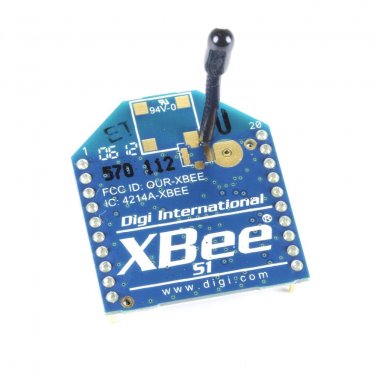
xBee 802.15.4 (Series 1)No configuration needed for out-of-the-box RF communicationsCommon XBee footprint for a variety of RF modulesFast 250 kbps RF data rate to the end node2.4 GHz for worldwide deploymentSleep modes supported for extended battery lifePerformance: XBeePower output:: 1mW (+0 dBm) North American & International versionIndoor/Urban range: Up to 100 ft(30 m)Outdoor/RF line-of-sight range: Up to 300 ft (90 m)RF data rate: 250 KbpsInterface data rate: Up to 115.2 KbpsOperating frequency: 2.4 GHzReceiver sensitivity:-92 dBmSeries 1 (802.15.4) and Series 2 (ZigBee Mesh) ComparisonXBee Series 1 (802.15.4)XBee Series 2Indoor/Urban rangeup to 100 ft. (30m)up to 133 ft. (40m)Outdoor RF line-of-sight rangeup to 300 ft. (100m)up to 400 ft. (120m)Transmit Power Output1 mW (0dbm)2 mW (+3dbm)RF Data Rate250 Kbps250 KbpsReceiver Sensitivity-92dbm (1% PER)-98dbm (1% PER)Supply Voltage2.8 - 3.4 V2.8 - 3.6 VTransmit Current (typical)45 mA (@ 3.3 V)40 mA (@ 3.3 V)Idle/Receive Current (typical)50 mA (@ 3.3 V)40 mA (@ 3.3 V)Power-down Current10 uA1 uAFrequencyISM 2.4 GHzISM 2.4 GHzDimensions0.0960" x 1.087"0.0960" x 1.087"Operating Temperature-40 to 85 C-40 to 85 CAntenna OptionsPCB, Integrated Whip, U.FL, RPSMAPCB, Integrated Whip, U.FL, RPSMANetwork TopologiesPoint to point, Star, Mesh (with DigiMesh firmware)Point to point, Star, MeshNumber of Channels16 Direct Sequence Channels16 Direct Sequence ChannelsFiltration OptionsPAN ID, Channel & Source/DestinationPAN ID, Channel & Source/DestinationSince hardware specifications are similar, the differences between XBee Series 1 and 2 are more evident in the firmware features. Listed below are some of the more defining differences in the firmware:802.15.4:XBee Series 1 comes standard with 802.15.4 firmware for point-point or star topology. This mature firmware offers ADC (analog-to-digital conversion) inputs, and digital and analog I/O line passing. The 802.15.4 XBee is significantly faster than ZigBee; RF latency can generally be calculated in 802.15.4. Throughput is also much higher, a practical maximum throughput is around 80kbps.ZigBee: XBee Series 2 does not offer any 802.15.4-only firmware; it is always running the ZigBee mesh firmware. The ZigBee XBee excels in very low-power scenarios, when configured as an End Device, this module has the lowest current draw of any Digi RF product. However, the infrastructure of a ZigBee network is more complex and requires more configuration to fully impliment. The main benefit of a ZigBee XBee is third-party device support and deep integration with iDigi and Digi's gateway products.One unique benefit of the 802.15.4 Series 1 XBee is that it can have the DigiMesh firmware installed. DigiMesh is Digi'sproprietarymesh network protocol and is directlycomparableto ZigBee. This allows a small network to beimplementedas a Star topology, then later converted into a full mesh network without replacing hardware.A whitepaper comparing DigiMesh and ZigBee can be found here:http://www.digi.com/pdf/wp_zigbeevsdigimesh.pdf.